Pyroecophysiology
The Pyroecophysiology Team is a network of international scientists focused on understanding the mechanisms of how heat from fires impact plant physiology, mortality, and recovery.
Pyro-ecophysiology focuses on how fire, within its environment, mechanistically interacts with the physiology of an organism. There are currently three branches of pyro-ecophysiology that the Pyroecophysiology Team explores:
(a) the mechanisms of why plants die in fire,
(b) the interactions of fire with droughts and other stressors, and
(c) the physiological drivers of flammability.
Key publications: Smith et al. (2017), Jolly and Johnson (2018), Smith et al. (2025).
The Pyroecophysiology Team also conducts research on how embers are generated and how to reduce the subsequent ignitions from those embers.
The University of Idaho part of the team has access to the Idaho Fire Initiative for Research and Education (IFIRE) Combustion Laboratory located at the University of Idaho, which includes physicists, fire ecologists, chemistry, plant ecophysiologists, and remote sensing scientists all interested in improving the mechanistic understanding of fire in the Earth system.
Our research mainly focuses on the United States with key partners at Texas Tech University, Washington State University, University of Utah, Colorado State University, and University of Georgia, and we regularly collaborate with fire scientists globally, including groups at the University of Tasmania Fire Center. We are working with collaborators to incorporate these results into new predictive models to help land management agencies and power companies better identify areas most at risk to wildfire ignition. Our research group also focuses on ways to increase community and home resilience to wildfires.
Our work is interdisciplinary and we are always open to new collaborations.
Pyro-ecophysiology focuses on how fire, within its environment, mechanistically interacts with the physiology of an organism. There are currently three branches of pyro-ecophysiology that the Pyroecophysiology Team explores:
(a) the mechanisms of why plants die in fire,
(b) the interactions of fire with droughts and other stressors, and
(c) the physiological drivers of flammability.
Key publications: Smith et al. (2017), Jolly and Johnson (2018), Smith et al. (2025).
The Pyroecophysiology Team also conducts research on how embers are generated and how to reduce the subsequent ignitions from those embers.
The University of Idaho part of the team has access to the Idaho Fire Initiative for Research and Education (IFIRE) Combustion Laboratory located at the University of Idaho, which includes physicists, fire ecologists, chemistry, plant ecophysiologists, and remote sensing scientists all interested in improving the mechanistic understanding of fire in the Earth system.
Our research mainly focuses on the United States with key partners at Texas Tech University, Washington State University, University of Utah, Colorado State University, and University of Georgia, and we regularly collaborate with fire scientists globally, including groups at the University of Tasmania Fire Center. We are working with collaborators to incorporate these results into new predictive models to help land management agencies and power companies better identify areas most at risk to wildfire ignition. Our research group also focuses on ways to increase community and home resilience to wildfires.
Our work is interdisciplinary and we are always open to new collaborations.
A New Paradigm in Fire Severity Research
|
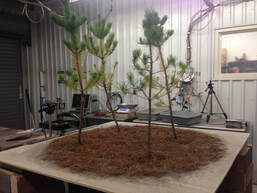
We are seeking to redefine fire severity through improving the mechanistic understanding of heat from fires on plants. Our experiments involve quantifying the amount of heat incident on plants and assessing how plant physiology mechanisms and morphology metrics change. Through this research we seek to better parameterize ecosystem and earth system models that incorporate fire processes.
|
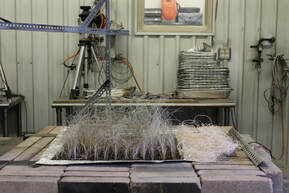
Ongoing research includes water, carbon, and nutrient relations in plants (grasses, shrubs, and trees) during and following fires. Understanding the mechanisms of why plants die from fires and how the productivity of the plant species is altered when the survive fires.
RECENT RESULTS IN A NUTSHELL
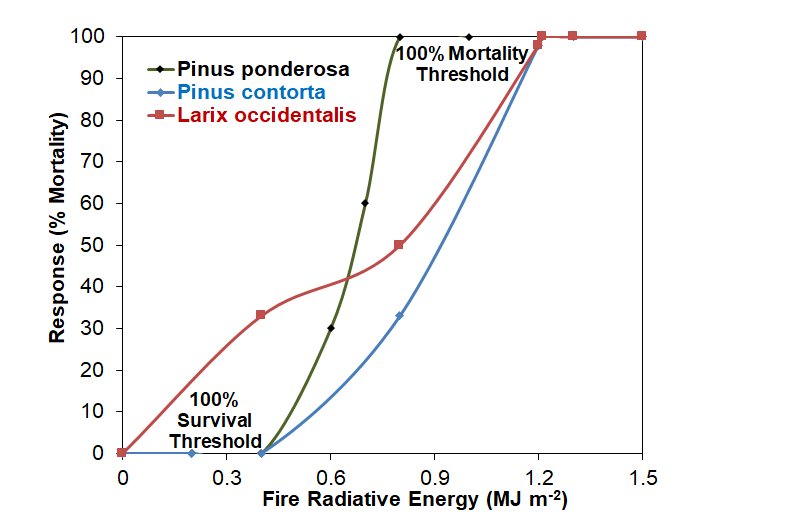
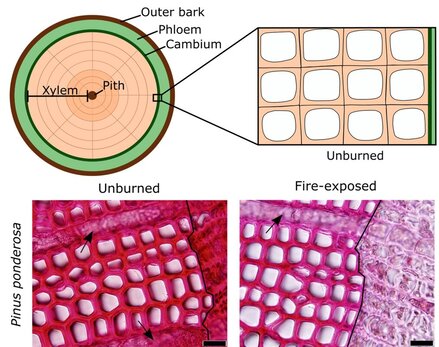
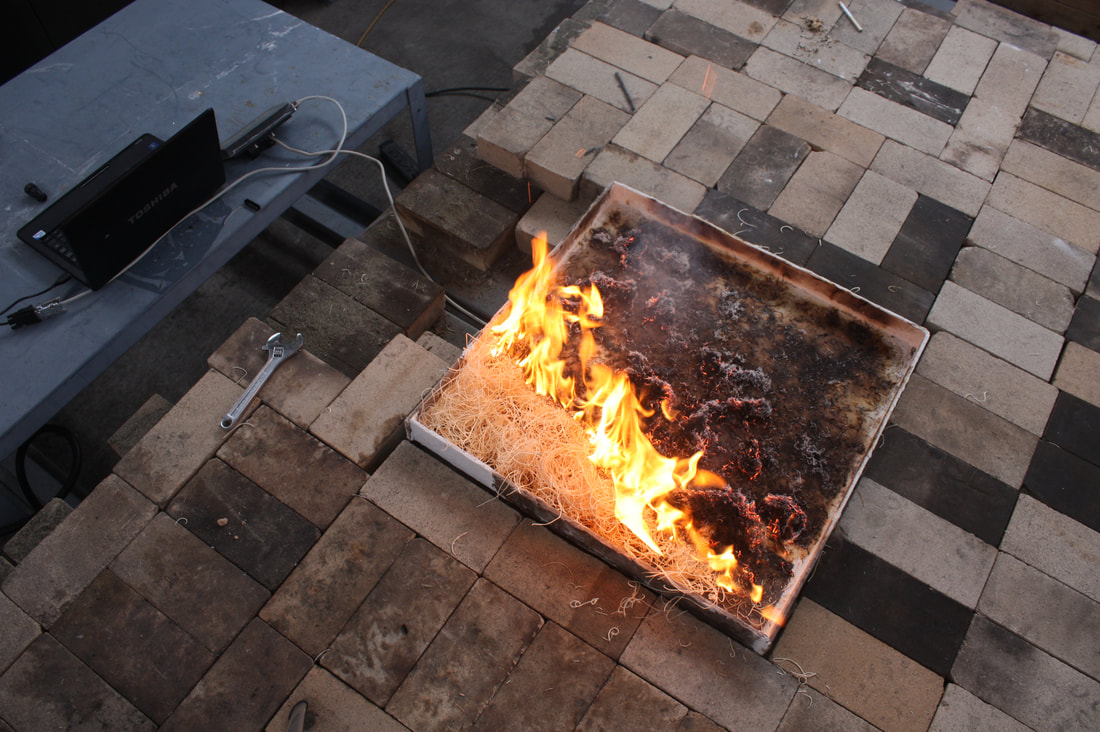
Through multiple experiments we have characterized the 'dose-response' of heat from fire incident on saplings on the subsequent probability of mortality. As shown in this summary figure on the bottom, we have characterized for 'well-watered' saplings the thresholds where 100% survival and 100% mortality occurs. We have also looked at how fire and drought interact across a range of species. The figure on the top is from Partelli Feltrin et al. (2021) where we determined that hydraulic failure was not the primary mechanism of fire induced mortality in Pinus ponderosa. This was also recently confirmed for Pinus monticola (Partelli-Feltrin et al. 2025). Further results from Parelli Feltrin et al. (2022) suggest that phloem death and not hydraulic failure drives fire-induced tree mortality in pines.
SPECIES EVALUATED
|
Fire Dose-Response (DR) Experiments
Pinus ponderosa
Pinus cortorta var. latifolia Pinus palustris Pinus monticola Pseudotsuga menziesii var. glauca Larix occidentalis Picea engelmannii Thuja plicata Populus tremuloides |
Fire x Drought Interaction Experiments
Pinus ponderosa
Pinus cortorta var. latifolia Pinus palustris Pinus monticola Pseudotsuga menziesii var. glauca Larix occidentalis |
Fire-Induced Mortality Experiments
Pinus ponderosa
Pinus monticola Pinus palustris |
SPECIES UNDER INVESTIGATION
|
Mortality and Fire x Drought Experiments
|
Fire x Fertilization Experiments
Pinus ponderosa
Pinus cortorta var. latifolia Pinus palustris Pinus monticola Pinus edulis Pinus echinata Pinus taeda |
FEATURED PYROECOPHYSIOLOGY PUBLICATIONS
|
Mortality and Recovery
INTERNATIONAL J OF WILDLAND FIRE
Blanco AS, Wilson DR, Hardman DD, Rainsford SW, Sparks AM, Bhatta RP, Adams HD, Johnson DM, Schwilk DW, Lutz JA, Knoblauch M, Huang L, Eldridge GM, Stanley MF, Logan JA, Smith AMS. 2025. Predicting the mortality of Pinus monticola and Pseudotsuga menziesii saplings using a pyro-ecophysiology fire severity approach. International Journal of Wildland Fire. 34, 11, WF25003. doi: 10.1071/WF25003. Publication Link.
|
Fire-Induced Mortality Mechanisms
INTERNATIONAL J OF WILDLAND FIRE
Partelli-Feltrin R, Smith AMS, Sparks AM, Foley ZA, Rainsford SW, Harley GL, Moberely JG, Adams HD, Schwilk DW, Tinkham WT, Hardman DD, Kok JR, Thompson RA, Hudak AT, Wilson DR, Hoffman CM, Lutz JA, Blanco AS, Cochrane MA, Kremens RL, Dahlen J, Boschetti L, Li L, Johnson DM. 2025. Methods to assess fire-induced tree mortality: Comparing heated water baths to experimental laboratory fires. International Journal of Wildland Fire. 34. 12. doi: 10.1071/WF24144. Publication Link.
|
|
Pyroecophysiology Ideas
INTERNATIONAL J OF WILDLAND FIRE
Smith AMS, Partelli-Feltrin R, Sparks AM, Moberly JG, Adams HD, Schwilk DW, Tinkham WT, Kok JR, Wilson DR, Thompson RA, Hudak AT, Hoffman CM, Lutz JA, Blanco AS, Cochrane MA, Kremens RL, Dahlen J, Harley GL, Rainsford SW, Huang L, Hardman DD, Johnson DM. 2025. Methods to assess fire-induced tree mortality: Review of fire behavior proxy and real fire experiments. International Journal of Wildland Fire. 34, WF24136. Publication Link (open access).
|
Flammability
AMERICAN JOURNAL OF BOTANY
Schwilk DW. Alam MA, Gill N, Murray BR, Nolan RH, Ondei S, Perry GLW, Smith AMS, Bowman DMJS, Fidelis A, Jaureguiberry P, Menor IO, Rosado BHP, Roland H, Yebra M, Yelenik SG, Curran TJ. 2025. From plant traits to fire behavior: scaling issues in flammability studies. American Journal of Botany. 10.1002/ajb2.70040 Publication Link.
|
Mortality and Recovery
REMOTE SENSING OF ENVIRONMENT
Sparks AM, Armstrong R, Smith AMS, Scharosch S, Corrao MV, Montzka T. 2025. Predicting fire-induced individual tree mortality at the landscape level using fire intensity and airborne laser scanning data. Remote Sensing of Environment. 331, 115007. https://doi.org/10.1016/j.rse.2025.115007
|
|
Mortality and Recovery
TREE PHYSIOLOGY
Sparks AM, Blanco A, Wilson DR, Schwilk DW, Johnson DM, Adams HD, Bowman DMJS, Hardman D, Smith AMS. 2023. Fire intensity impacts on physiological performance and mortality in Pinus monticola and Pseudotsuga menziesii: a dose-response analysis. Tree Physiology. 43, 8, 1365-1382. Publication Link.
|
Mortality and Recovery
FOREST ECOLOGY AND MANAGEMENT
Sparks AM, Smith AMS, Hudak AT, Corrao MV, Kremens RL, Keefe RF. 2023. Integrating active fire behavior observations and multitemporal airborne laser scanning data to quantify fire impacts on tree growth: a pilot study in mature Pinus ponderosa stands. Forest Ecology and Management. 545, 121246. Publication Link.
|
Fire x Drought Interactions
FOREST SCIENCE
Sparks AM, Blanco AS, Lad LE, Smith AMS, Adams HD, Tinkham WT. 2024. Pre-fire drought intensity drives post-fire recovery and mortality in Pinus monticola and Pseudotsuga menziesii saplings. Forest Science. 70, 2, 189-201. Publication Link.
|
|
Fire-Induced Mortality Mechanisms
NEW PHYTOLOGIST
Partelli-Feltrin R, Smith AMS, Adams HD, Thompson A, Kolden CA, Yedinak KM, Johnson DM. 2023. Death from hunger or thirst? Phloem dysfunction, rather than xylem hydraulic failure, as a driver of fire-induced conifer mortality, New Phytologist. Publication Link.
|

Fire x Drought Interactions
FIRE
Partelli-Feltrin R, Johnson DM. Sparks AM, Adams HD Kolden CA, Nelson AS, Smith AMS. 2020. Drought increases vulnerability of Pinus ponderosa saplings to fire-induced mortality, Fire, 3, 56. Publication Link.
|
Fire x Drought Interactions
FIRE
Wilson LA, Spencer RN, Aubrey DP, O’Brien JJ, Smith AMS, Thomas RW, Johnson DM. 2022. Longleaf Pine Seedlings are Extremely Resilient to the Combined Effects of Experimental Fire and Drought, Fire. 5, 5, 128 Publication Link.
|
|
NATURE ECOLOGY AND EVOLUTION
|
FIRE
|
PLANT CELL AND ENVIRONMENT
|
|
Smith AMS Kolden CA, Bowman DMJS. 2018. Biomimicry can help humans to sustainably coexist with fire. Nature Ecology and Evolution, 2, 1827-1829.
Publication Link |
Steady WD, Partelli-Feltrin R, Johnson DM, Sparks AM, Kolden CA, Talhelm AF, Lutz JA, Boschetti L, Hudak AT, Nelson AS, Smith AMS. 2019. The survival of Pinus Ponderosa saplings subjected to increasing levels of fire intensity and impacts on post-fire growth, Fire, 2, 2, 23.
Publication Link. |
Partelli-Feltrin R, Smith AMS, Adams HD, Kolden CA, Johnson DM. 2021. Short- and long-term effects of fire on stem hydraulics in Pinus ponderosa saplings, Plant, Cell, and Environment, 44, 3, 696-705.
Publication Link. |
|
Mortality and Recovery
INTERNATIONAL J OF WILDLAND FIRE
Sparks AM, Smith AMS, Talhelm AF, Kolden CA, Yedinak KM, Johnson DM. 2017. Impacts of fire radiative flux on mature Pinus ponderosa growth and vulnerability to secondary mortality agents, International Journal of Wildland Fire, 26, 1, 95-106.
Publication Link. |
Fire x Drought Interactions
INTERNATIONAL J OF WILDLAND FIRE
Sparks AM, Talhelm AF, Partelli-Feltrin R, Smith AMS, Johnson DM, Kolden CA, Boschetti L. 2018. An experimental assessment of the impact of drought and fire on western larch mortality and recovery. International Journal of Wildland Fire, 27, 7, 490-497.
Publication Link. |
Mortality and Recovery
INTERNATIONAL J OF WILDLAND FIRE
Smith AMS, Talhelm AF, Johnson DM, Sparks AM, Yedinak KM, Apostol KG, Tinkham WT, Kolden CA, Abatzoglou JT, Lutz JA, Davis AS, Pregitzer KS, Adams HD, Kremens RL. 2017. Effects of fire radiative energy density doses on Pinus contorta and Larix occidentalis seedling physiology and mortality, International Journal of Wildland Fire, 26, 1, 82-94.
Publication Link. |
|
Pyroecophysiology Ideas
|
Mortality and Recovery
|
Drought and Insects
|
|
INTERNATIONAL J OF WILDLAND FIRE
Smith AMS, Sparks AM, Kolden CA, Abatzoglou JT, Talhelm AF, Johnson DM, Boschetti L, Lutz JA, Apostol KG, Yedinak KM, Tinkham WT, Kremens RJ. 2016. Towards a new paradigm in fire severity research using dose-response experiments, International Journal of Wildland Fire, 25, 158-166.
Publication Link. |
ECOSPHERE
McNellis B, Smith AMS, Hudak AT, Strand EK. 2021. Tree mortality in Western U.S. forests forecasted using forest inventory and Random Forest classification, Ecosphere, 12, 3, e03419
Publication Link. |
ECOHYDROLOGY
Adams, HD, Luce, CH, Breshears, DD, Weiler, M, Hale, CH, Allen, CD, Smith, AMS, Huxman, TE., 2012. Ecohydrological consequences of drought- and infestation-triggered tree die-off, Ecohydrology, 5, 2, 145-159.
Publication Link. |
|
Flammability
ECOSPHERE
Talhelm AF, Smith AMS, 2018. Litter moisture adsorption is tied to tissue structure, chemistry, and energy concentration, Ecosphere, 9 (4), e02198.
Publication Link. |
Mortality and Recovery
BIOGEOSCIENCES Sparks AM, Kolden CA, Smith AMS, Boschetti L, Johnson DM, Cochrane MA, 2018. Fire intensity impacts on post-fire response of temperate coniferous forest net primary productivity, Biogeosciences, 15, 4, 1173-1183. Publication Link.
|
Mortality and Recovery
REMOTE SENSING
Sparks AM, Kolden CA, Talhelm AF, Smith AMS, Apostol KG, Johnson DM, Boschetti L. 2016. Spectral indices accurately quantify changes in tree physiology following fire: toward mechanistic assessments of landscape post-fire carbon cycling, Remote Sensing, 8, 7, 572. Publication Link.
|
FIRE SCIENCE SYNTHESES
|
PHIL. TRANS. OF THE ROYAL SOCIETY - B
Little K, Vitali R, Belcher CM, Kettridge N, Pellegrini AFA, Ford AES, Smith AMS, Elliot A, Voulgarakis A, Stoof CR, Kolden CA, Schwilk DW, Kennedy EB, Thacker N, Millin-Chalabi GR, Clay GD, Morrison J, McCarty JL, Ivison K, Tansey K, Simpson KJ, Jones MW, Mack MC, Fule PZ, Gazzard R, New S, Page SE, Hall TE, Brown T, Jolly WM, Doerr SH. 2025. Priority research directions for wildfire science: views from a historically fire-prone and an emerging fire-prone country. Philosophical Transactions of the Royal Society B. 380 (1924), 2024001. Publication Link.
REMOTE SENSING OF ENVIRONMENT
Wooster MJ, Roberts GJ, Giglio L, Roy DP, Freeborn P, Boschetti L, Justice CO, Ichoku CM, Schroeder W, Davies DK, Smith AMS, Setzer A Csiszar I, Strydom T, Frost P, Zhang T, Xu W, De Jong M, Johnson JM, Ellison L, Vardrevu KP. Sparks AM, Nguyen H, McCarty JL. Tanpipat V, Schmidt C, San-Miguel-Ayanz J. 2021. Satellite Remote Sensing of Active Fires: History and Current Status, Applications and Future Requirements, Remote Sensing of Environment, 267, 112694.
Publication Link. |
BIOSCIENCE
Gilvarg SC, Leydet B., Dovciak M, Smith AMS, Miller SL, Luckhart S, Lashley MA, Vander Yacht AL. 2025. Pyro-Health Synchrony: Integrating Wildland Fire into One Health to Benefit Plants, Animals, Ecosystems, and People. BioScience. biaf068. Publication Link.
PNAS NEXUS
Shuman JK, Balch JK, Barnes RT, Higuera PE, Roos CI, Schwilk DW, Stavros EN, Banerjee T, Bela M, Bendix J, Bertolino S, Bililgn S, Bladon KD, Brando P, Breidenthal RE, Buma B, Calhoun D, Carvalho LMV, Cattau M, Cawley KM, Chandra S, Chipman ML, Cobian-Inguez J, Conlisk E, Coop J, Cullen A, Davis KT, Dayalu A, De Sales F, Dolman M, Ellsworth LM, Franklin S, Guiterman CH, Hamilton M, Hanan EJ, Hansen WD, Hantson S, Harvey BJ, et al. 2022. Reimagine fire science for the Anthropocene, PNAS Nexus, 1, 3, pgac115. Publication Link.
|

BIOSCIENCE
Gilvarg SC, Leydet B., Dovciak M, Smith AMS, Miller SL, Luckhart S, Lashley MA, Vander Yacht AL.2025. Challenge: How can sustainability policy and research frameworks evolve to include multispecies justice as a core principle of planetary health? BioScience. In Press.
BIOSCIENCE
Smith, AMS, Kolden, CA, Paveglio, T, Cochrane, MA, Mortitz, MA, Bowman, DMJS, Hoffman, CM, Lutz, J, Queen, LP, Hudak, AT, Alessa, L, Kliskey, AD, Goetz, S, Yedinak, KM, Boschetti, L, Higuera, PE, Flannigan, M, Strand, EK, van Wagtendonk, JW Anderson, JW Stocks, BJ and Abatzoglou, JT. 2016. The science of firescapes: achieving fire resilient communities, BioScience, 66, 2, 130-146.
Publication Link. |
|
NATURE ECOLOGY AND EVOLUTION
Bowman DMJS, Williamson G, Kolden CA, Abatzoglou, JT Cochrane MA, Smith AMS. 2017. Human exposure and sensitivity to globally extreme wildfire events, Nature: Ecology and Evolution, 1, 0058.
Publication Link. |
BIOSCIENCE
Meddens AJH, Kolden CA, Lutz JA, Smith AMS, Cansler A, Abatzoglou JT, Meigs GW, Downing WM, Krawchuk MA. 2018. Fire refugia: What are they and why do they matter for global change? BioScience, 68, 12, 944-954.
Publication Link. |
JAMES
Hanan EJ, Kennedy MC, Ren J, Johnson MC. Smith AMS, 2022. Missing climate feedbacks in fire models: limitations and uncertainties in fuel loadings and the role of decomposition in fine fuel succession, Journal of Advances in Modeling Earth Systems, 14, 3, e2021MS002818. Publication Link.
|
RECENT LIDAR AND UAS RESEARCH
|
FORESTS
Sparks AM, Corrao MV, Keefe RF, Armstrong R, Smith AMS. 2025. Comparison of field sampling- and airborne laser scanning-derived stand level inventories in a mixed conifer forest and volume validation using log scaling data. Forests. 16, 5, 784. Publication Link.
|
REMOTE SENSING
Montzka T, Schatosch S, Huebschmann M, Corrao MV, Hardman DD, Rainsford SW, Smith AMS, and the Confederated Bands and Tribes of the Yakama Nation. 2025. Comparison of a continuous forest inventory to an ALS-derived digital inventory in Washington, State. Remote Sensing. 17, 10, 1761. Publication Link.
|
FORESTS
Kondratev M, Corrao MV, Armstrong R, Smith AMS. 2025. Assessing the uncertainty of traditional sample-based forest inventories in mixed and single species conifer systems. Forests, 16, 11, 1617. Publication Link.
|
|
FOREST SCIENCE
Sparks AM, Corrao MV, Keefe RF, Smith AMS. 2024. An accuracy assessment of field- and airborne laser scanning-derived individual tree inventories using felled tree measurements and log scaling data in a mixed conifer forest. Forest Science. 70, 3, 228-241. Publication Link.
|
FOREST ECOLOGY AND MANAGEMENT
Sparks AM, Smith AMS, Hudak AT, Carrao MV, Kremens RL, Keefe RF. 2023. Integrating active fire behavior observations and multitemporal airborne laser scanning data to quantify fire impacts on tree growth: a pilot study in mature Pinus ponderosa stands. Forest Ecology and Management. 545, 121246. Publication Link.
|
REMOTE SENSING
Lad LE, Tinkham WT, Sparks AM. Smith AMS, 2023. Evaluating Predictive Models of Tree Foliar Moisture Content using Multispectral UAS Data: A Laboratory Study, Remote Sensing. 15, 5703. Publication Link.
|
|
FORESTS
|
REMOTE SENSING
|
REMOTE SENSING
|
|
Sparks AM, Smith AMS. 2022. Accuracy of a LiDAR-based individual tree detection and attribute measurement algorithm developed to inform forest products supply-chain and resource management, Forests. 13, 3.
Publication Link. |
Sparks AM, Corrao MV, Smith AMS. 2022. Cross-comparison of Seven Individual Tree Detection Methods using Low and High Pulse Density Airborne Laser Scanning Data, Remote Sensing. 14, 14, 3480. Publication Link.
|
Corrao MV, Sparks AM, Smith AMS. 2022. A conventional cruise and felled-tree validation of individual tree dimeter, height, and volume derived from airborne laser scanning data of a loblolly pine (P. taeda) stand in Eastern Texas, Remote Sensing, 14, 11, 2567. Publication Link.
|